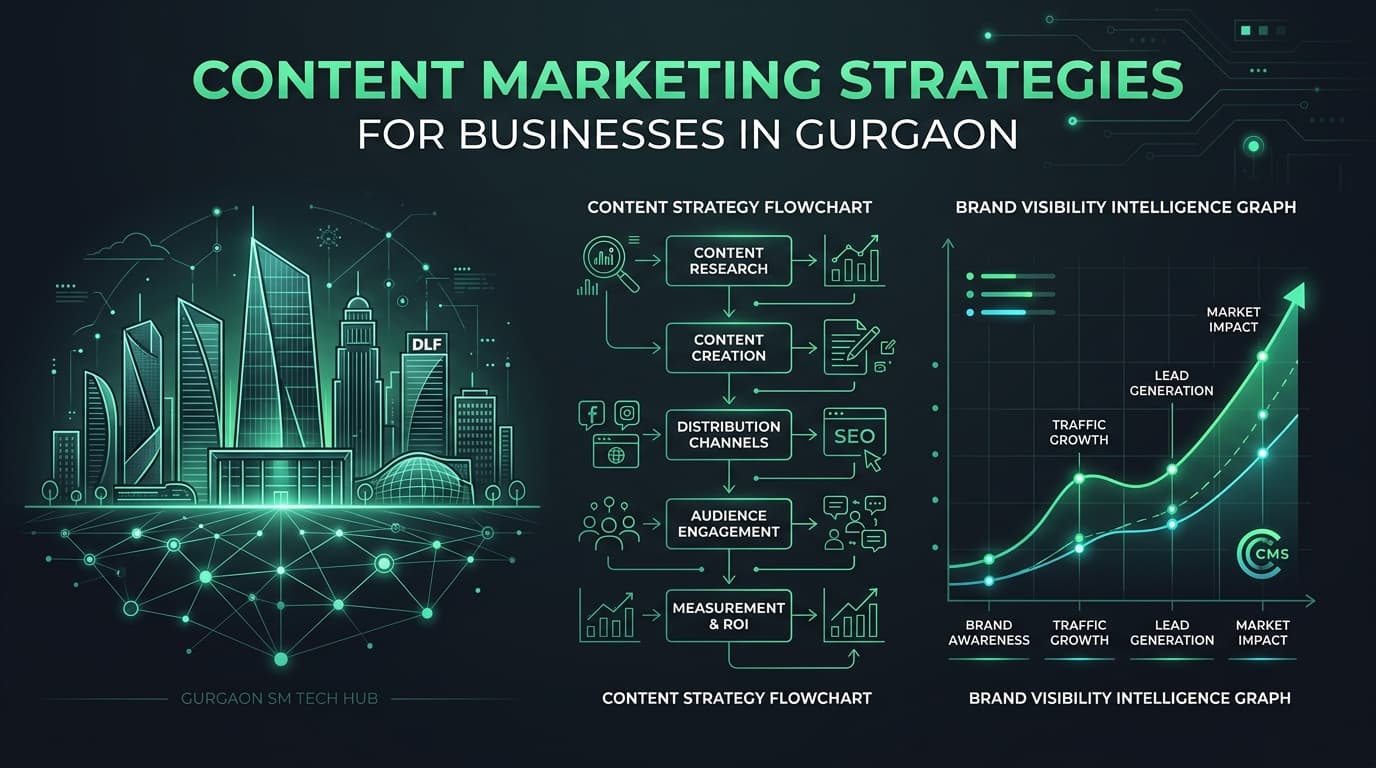
Introduction: The Gurgaon Content Paradox
Gurugram (Gurgaon) is undeniably India’s premier corporate capital. From the glass towers of DLF Cyber City and Golf Course Road to the manufacturing and tech corridors of Udyog Vihar and Sohna Road, the city houses over 250 Fortune 500 regional headquarters, dozens of unicorns, and thousands of agile B2B startups.
Yet despite operating in one of the most competitive commercial hubs on the planet, most Gurgaon-based companies are trapped in an outdated content playbook.
They hire traditional marketing agencies on generic monthly retainers, churning out 600-word keyword-stuffed blog posts, vanity infographics, and automated social cards. The result? Negligible organic traffic, zero qualified sales calls, and complete invisibility when enterprise buyers ask AI tools for vendor recommendations.
In 2026, content marketing is no longer about publishing volume. It is an orchestrated brand intelligence and pipeline engine.
Below is the definitive playbook for marketing leaders, founders, and growth operators in Gurgaon looking to capture high-value enterprise pipeline, dominate traditional organic search, and ensure their brand is recommended across AI answer engines.
The Shift: Traditional SEO vs. Modern Brand Engines
For years, local marketing playbooks prioritized top-of-funnel search volume. Agencies measured success by impressions, clicks, and ranking for loose queries.
Today, B2B buyers in NCR don't start and end their research on standard search engine results pages. They consult conversational AI assistants (ChatGPT, Claude, Perplexity), evaluate peer discussions on LinkedIn and Reddit, and dissect bottom-of-funnel comparison breakdowns.
| Strategic Dimension | Legacy Gurgaon Agency Playbook | Modern Brand Visibility Engine |
|---|---|---|
| Primary Goal | Vanity traffic & keyword impression volume | High-intent demo requests, pipeline, & brand equity |
| Search Surface | Google 10-blue-links search results | Omnichannel: Google + AI Answer Engines (Perplexity, ChatGPT) + LinkedIn |
| Content Type | Surface-level 600-word generic listicles | Deep, opinionated teardowns, proprietary benchmarks, & BOFU comparison pages |
| AI Readiness | Ignored (unstructured content, no entity schemas) | Answer Engine Optimization (AEO), Share of Model tracking, & verified entity citations |
| Attribution | Last-click vanity metrics & bounce rate | Inbound pipeline, sales cycle acceleration, & executive authority |
4 Core Pillars of an Effective Gurgaon Content Strategy
To stand out in Delhi-NCR’s crowded enterprise landscape, your content marketing operation must execute across four interconnected pillars:
1. High-Intent Bottom-of-Funnel (BOFU) Content
Top-of-funnel guides ("What is Digital Transformation?") bring low-intent readers who never convert. High-growth teams focus 60% of their production on high-intent decision assets:
- "Alternative To" & Competitor Teardowns: Unbiased comparisons showing exactly where your product outperforms legacy competitors.
- Workflow-Specific Guides: Tactical walkthroughs addressing the exact operational bottlenecks faced by VP and Director-level buyers.
- Enterprise ROI Calculators: Transparent frameworks showing payback period, implementation timelines, and unit economic upside.
Pro Tip: If your sales team repeatedly answers the same five objections during product demos in CyberHub or Horizon Center boardrooms, turn those exact answers into public, indexable deep-dives.
2. Answer Engine Optimization (AEO) & Entity Authority
When an executive asks Perplexity, "Which B2B SaaS platforms in India handle cross-border tax compliance best?", does your brand get cited in the direct answer?
Answer engines don't crawl the web like traditional indexers. They look for consensus, verified entity relationships, and structured facts across high-authority sources.
- Structure key definitions and product capabilities into declarative, concise 2-sentence summaries.
- Implement comprehensive Organization, SoftwareApplication, and FAQ JSON-LD schemas.
- Monitor your Share of Model (SoM) across LLMs to flag hallucinations or missing citations before competitors displace your brand.
3. Founder-Led & Executive Thought Leadership on LinkedIn
Gurgaon runs on LinkedIn. CXOs, enterprise procurement heads, and tech founders in NCR treat LinkedIn as their primary professional watering hole.
- Ghostwritten, corporate platitudes on company pages generate zero engagement.
- Instead, extract raw insights from your founders, VP of Engineering, or Head of Product. Document real production challenges, architectural decisions, and market trends.
- Repurpose these executive posts into long-form blog articles and case studies to capture both social distribution and organic search longevity.
4. Verticalized Industry Nuance (NCR-Specific Depth)
Gurgaon's enterprise economy is defined by four massive sectors:
- Fintech & Insurtech: Demanding deep compliance, data sovereignty, and security certifications (SOC 2, ISO 27001).
- Enterprise SaaS & IT Services: Prioritizing API robustness, integrations with legacy ERPs, and developer-friendly documentation.
- PropTech & Real Estate: Requiring hyper-localized market insights, asset intelligence, and investor trust.
- Supply Chain, Logistics & Mobility: Focused on route optimization, IoT telemetry, and turnaround efficiency.
Your content must reflect the exact terminology, regulatory standards, and operational reality of your target vertical—not generic advice translated from US marketing blogs.
Tactical 5-Step Execution Roadmap
Step 1: Audit AI & Search Footprint ➔ Step 2: Build BOFU Comparison Assets
                                                   │
Step 4: Distribute via Exec LinkedIn ◄──────────── Step 3: Publish Proprietary Data
         │
         ▼
Step 5: Track Pipeline & Entity Health (BIU)
Step 1: Audit Your Current Citation & Search Footprint
Before writing a single new piece of copy, discover where you currently stand. Query ChatGPT, Claude, and Perplexity for your top 10 commercial categories. Note whether your company appears, what claims the AI makes about your pricing or features, and which competitors are cited.
Step 2: Publish Problem-Solving Comparison Assets
Build out structured comparison pages between your solution and legacy market leaders. Ensure tables use clean, machine-readable formatting (markdown or HTML tables) with distinct feature matrices.
Step 3: Release Proprietary Data & Benchmark Reports
Gurgaon’s media and corporate networks love original data. Survey your user base, anonymize platform telemetry, or compile regional pricing benchmarks. Original data creates a natural backlink magnet and earns authoritative citations that AI models index as authoritative truth.
Step 4: Synchronize Multi-Channel Distribution
Every long-form piece should yield:
- One comprehensive canonical blog post.
- Two executive LinkedIn posts detailing core takeaways.
- A concise email breakdown sent to your prospect list.
- An updated entry in your internal sales enablement repository.
Step 5: Protect Brand Reputation & Citation Accuracy
As your content library expands, outdated product details, broken links, or legacy claims can confuse AI models and buyers alike. Use continuous brand intelligence to detect hallucinated details, track brand sentiment, and approve fixes quickly.
Conclusion: Transform Content into a Verifiable Asset
Content marketing in Gurgaon is moving past the era of agency vanity metrics. The winning brands of the next five years will be those that treat content as an authoritative knowledge base—one that builds trust with human decision-makers and informs the AI algorithms that advise them.
If you are unsure how AI search engines and modern buyers currently perceive your brand, take control of your narrative today.
Next Step: Run a free brand scan with Boast It Up (BIU) to analyze your brand’s AI visibility, uncover missing citations, and generate actionable fixes for your marketing team.